
When she told you, everything changed. Including the bottle on your vanity.
The scent you've worn for years lists one word on its label: parfum — and the law lets that word hide almost anything. Below: what the evidence says about endocrine disruptors during pregnancy and nursing, and the Aimée de Mars fragrances cleared under our standard for this season. For the scent you wear around her — and the one she wears herself.

You're right to check
If you turned your perfume over this week and really read the label — perhaps for the first time in years — that instinct is exactly right. Fragrance is one of the last products on a vanity still allowed to keep its recipe secret. A pregnancy in the family is the moment that stops being acceptable.
You are not being asked to give up fragrance. You're being asked, by your own good judgment, to finally know what's in it. This page exists to answer that.
The “Parfum” Loophole
A perfume holds, on average, fifty to one hundred ingredients. The label typically discloses one of them: parfum. Cosmetic law allows an entire formula to shelter behind that single word — so the bottle you've reached for every morning for fifteen years may legally contain compounds you've chosen to avoid in every other product you own.
Alcohol Denat. · Aqua · Limonene · Linalool · Benzyl Salicylate · Citronellol · Geraniol · Parfum (Fragrance) · Coumarin · Hydroxycitronellal
Phthalates
Added to make a scent linger. Several appear on the ECHA Candidate List of substances of very high concern; diethyl phthalate (DEP) is rarely, if ever, declared on a conventional label.
Synthetic musks
Galaxolide and Tonalide are bioaccumulative — and have been documented in human breast milk in peer-reviewed monitoring studies. Neither typically appears on a North American label.
Nitro musks
Musk xylene and musk ketone: banned or severely restricted under EU and IFRA rules, yet still surfacing in legacy formulations sold where oversight is weaker.
Why this matters now, specifically. The endocrine system orchestrates fetal development, and early gestation contains windows in which even parts-per-billion exposures matter. That pregnancy warrants caution around endocrine disruptors is not a fringe position — it is the stated consensus of ECHA, EFSA, and the Endocrine Society. The scientific debate is over which compounds at which doses. Not over whether to be careful.
None of these substances appears on a typical fragrance label. All of them sit on the regulators' watch lists. That asymmetry is the entire problem.

Natural was never the compromise. Undisclosed was.
Somewhere along the way, the industry taught us there were two options: fine fragrance with hidden chemistry, or “clean” fragrance that smells like an apology.
Aimée de Mars was built on a third: perfumery as botany. Whole plant extracts — rose absolute, neroli, frankincense — each with a name you can read on the label and look up for yourself. Composed in Provence by a perfumer-botanist, not assembled from a synthetic palette no one will show you.
A fragrance joins our pregnancy collection only when
Every constituent is declared on the INCI — nothing behind parfum.
The full formula is cross-checked against the ECHA Candidate List, with particular attention to endocrine-disrupting properties.
Allergen concentrations are documented against the EU’s 26-declarable list.
Every essential oil is reviewed against the aromatherapy literature on pregnancy contraindications.
Valérie Demars signs the classification personally.
Of our fifty-four fragrances, thirty-seven pass. We exclude a third of our own collection.
The rest are excellent fragrances — in a different season of life. That is what a standard costs, and what makes it worth trusting.
We'll help you find the one — risk-free.
Whether it's the scent you'll wear or the one you'll give her, the discovery set is how you find it — seven cleared fragrances, tried on your own skin, over a few unhurried weeks, with every ingredient in plain view.
Seven to try. Nothing to risk.
You wear all seven vials over sixty days, find the one your skin holds best, and your $58.50 is credited in full toward its full-size bottle. Try the whole collection — the trial itself costs nothing.
You buy the seven-vial set today for $58.50.
You take 30 days to find your favourite — slowly, on skin, the way natural perfume reveals itself.
You claim your full-size bottle with your $58.50 credit applied. Your trial cost is gone.
A unique credit code is sent the moment your order ships, locked to your account, valid for 30 days. We'll remind you before it expires — no rush.
Choose your discovery set
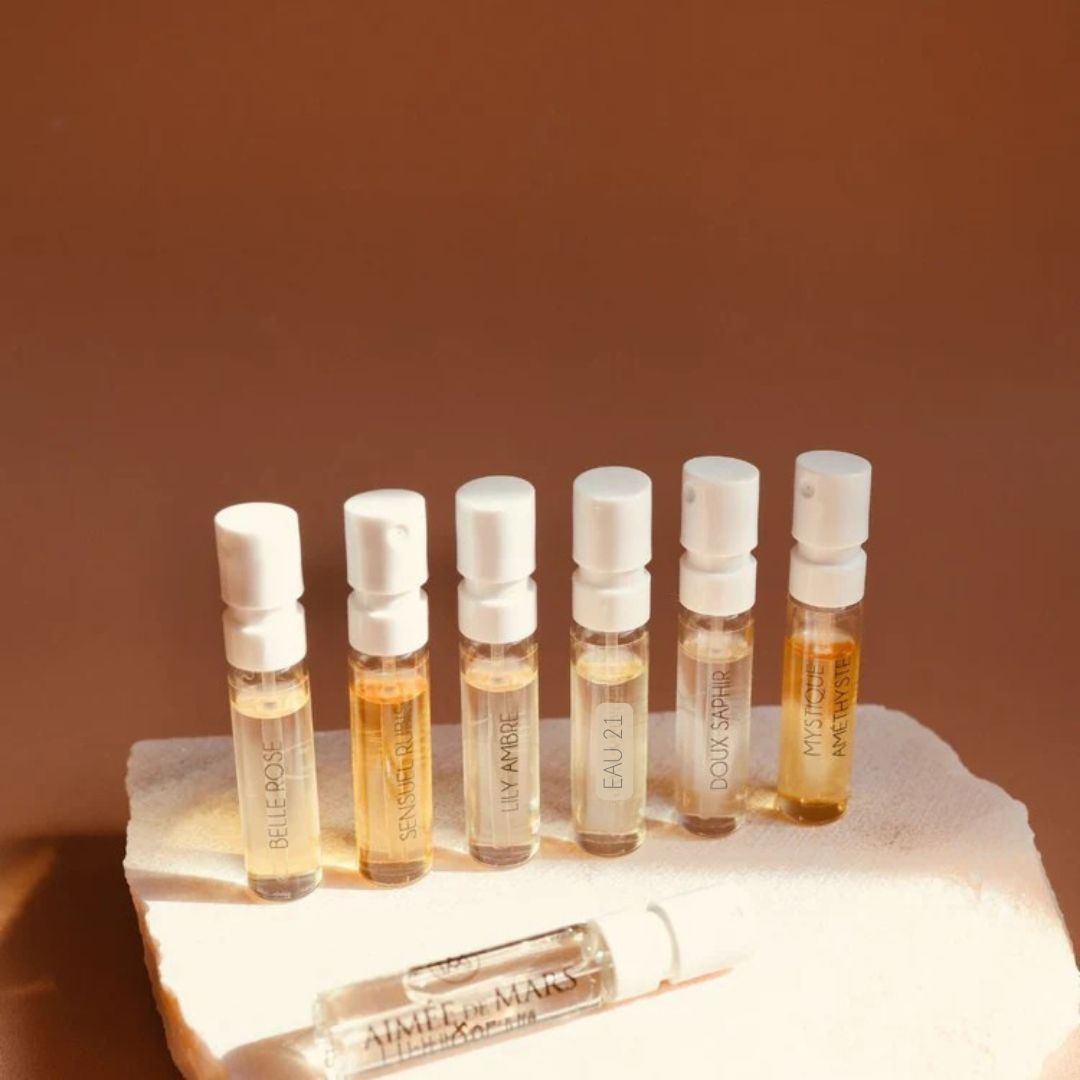
Originelle Set
Our founding seven — powdery roses and soft iris, an oriental depth, and a fresh, joyful close.
- BELLE ROSEPowdery rose
- MYTHIQUE IRISPowdery almond
- LILY AMBREAmbered & solar
- DOUX SAPHIRPowdery violet
- MYSTIQUE AMÉTHYSTEOriental
- NATASHARosy oriental
- EAU 21Fresh & joyful
Your $58.50 credits back, in full, against the full-size bottle of the one you choose.
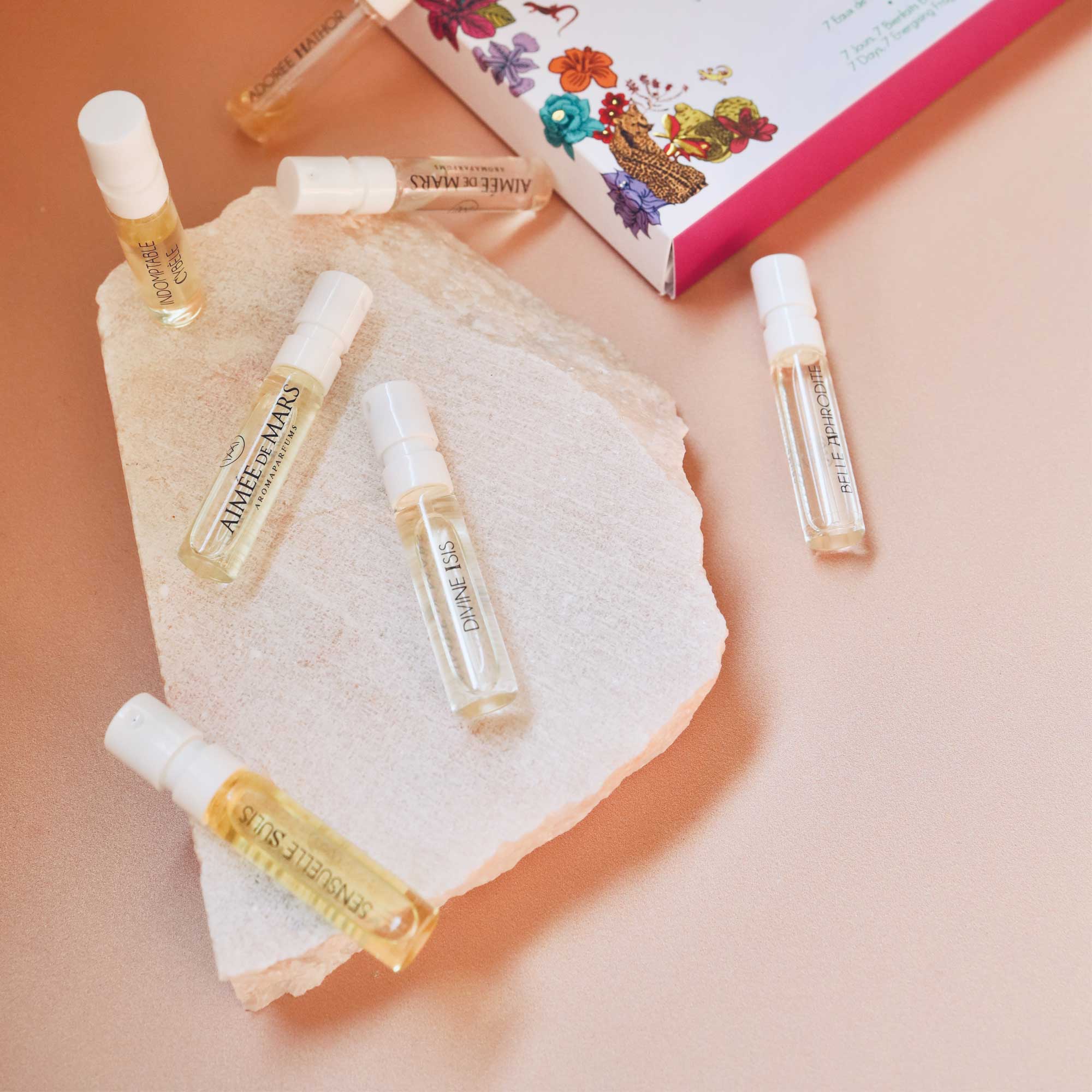
Déesses Set
Seven goddesses, seven moods — solar florals, an almond cocoon, ambered woods and a citrus lift.
- ADORÉE HATHORSolar & floral
- BELLE APHRODITESoft & floral
- DIVINE ISISCocooning & almond
- DOUCE OPHÉLIASolar freshness
- INDOMPTABLE CYBÈLEAmbered & woody
- PÉTILLANTE AURORECitrus freshness
- SENSUELLE SULISOriental balm
Your $58.50 credits back, in full, against the full-size bottle of the one you choose.
A single set ships for a small fee, calculated at checkout.
Every fragrance in these sets is cleared under the Aimée Standard and signed by Valérie Demars.
Wearing fragrance through the trimesters
This guide is general information from the maison, not medical advice. Every pregnancy is different — please confirm anything you wear or apply with your doctor or midwife.
First trimester
Scent sensitivity often heightens. It’s hormonal, not psychological, and usually fades by mid-second trimester. Lean citrus-forward — bergamot, neroli, mandarin — and apply to a single pulse point.
Second trimester
Usually the most comfortable window. Well-perfused skin lets florals and soft woods bloom cleanly.
Third trimester
Warmer skin projects more; a lighter hand keeps a scent proportionate.
During nursing
Keep fragrance away from any skin in direct contact with the baby. The nape of the neck and the backs of the wrists, rather than the décolleté.
The grandmother, the sister, the friend
The nursing rule is yours too. You’ll be holding that baby. Apply where a small head won’t rest, and wear bottles whose contents you can actually read.
Prefer it in your inbox?
We'll send the full guide, the complete list of 37 cleared fragrances, and the INCI reading sheet as a PDF.

Buying for your daughter — or your best friend?
Whether she's your daughter or the friend who told you, you already know the difficulty of choosing a scent for someone else — and the particular difficulty of choosing one for someone pregnant. The discovery set resolves both. She finds the composition her skin holds best; every ingredient is declared, so she and her midwife can read exactly what's in it; and the $58.50 credit toward her full bottle travels with the gift.
You're not choosing her perfume. You're handing her the first bottle on her shelf that answers every question — beautifully.
Give a discovery set →Independently verified
Cosmos Natural certified
100% natural-origin formulations, third-party verified by Ecocert.
Screened for endocrine disruptors
Against the ECHA Candidate List and EU priority lists. No phthalates, parabens, or synthetic musks.
Selected by Valérie Demars
Every formulation reviewed and signed before it joins the collection. Reclassified when the evidence changes.
Made in Provence
Formulated, blended, and bottled in Mévouillon. Full INCI on every product page.
For the detail-oriented reader
Read the full evidence +Hide the evidence −
The full deep-dive essay — regulatory citations, the peer-reviewed monitoring literature on synthetic musks in breast milk, and the endocrine-disruption windows of gestation — lives here, in full, for the reader who wants to verify every claim on this page for themselves.
Questions you may be googling next
I’m not the one who’s pregnant. Does my perfume really matter around her, or the baby?
The strongest evidence concerns what a pregnant or nursing woman wears on her own skin. But close contact is its own exposure route: fragrance transfers by touch and shares air at hugging distance — and a grandmother’s shoulder is where a newborn sleeps. Our view: apply the nursing logic to yourself. Fragrance away from where the baby rests, and a label that declares everything, so the question never has to be argued from a bottle that won’t answer it.
How do you decide which fragrances qualify?
Five criteria: full INCI declaration, ECHA Candidate List screening, documented allergen concentrations, essential-oil review against the pregnancy contraindication literature, and Valérie Demars’s personal sign-off. Thirty-seven of fifty-four pass.
Is natural automatically safer than synthetic?
No — and any brand that says otherwise is selling you a word. Several natural essential oils are contraindicated during pregnancy: sage, pennyroyal, wintergreen, and others. Natural gives you transparency. Safety comes from the review. That’s why criterion four exists.
What if she has a known fragrance allergy?
Every constituent is on the label, and the EU’s 26 declarable allergens — linalool, limonene, citronellol, and the rest — are listed individually. She, and her allergist, can check the actual composition before it ever touches skin.
How does the discovery-set credit work?
The cost of any discovery set is credited against a 30 ml or 50 ml bottle within 30 days. Find the one, and the set effectively cost nothing.
Why aren’t all fifty-four fragrances in this collection?
Because a standard that admits everything isn’t a standard. Some of our compositions use materials that are wonderful in another season and unsuitable in this one. We’d rather say so.
She's about to become a mother.
You've already decided that “what's in it?” can no longer be answered with “we're not allowed to know.” What remains is choosing which of thirty-seven cleared compositions becomes yours — and, when she's ready, hers.
The first trimester is the window of highest sensitivity — every week with an undisclosed formula is a week you didn't need to spend.
Every ingredient declared. Love and care in every bottle.

