

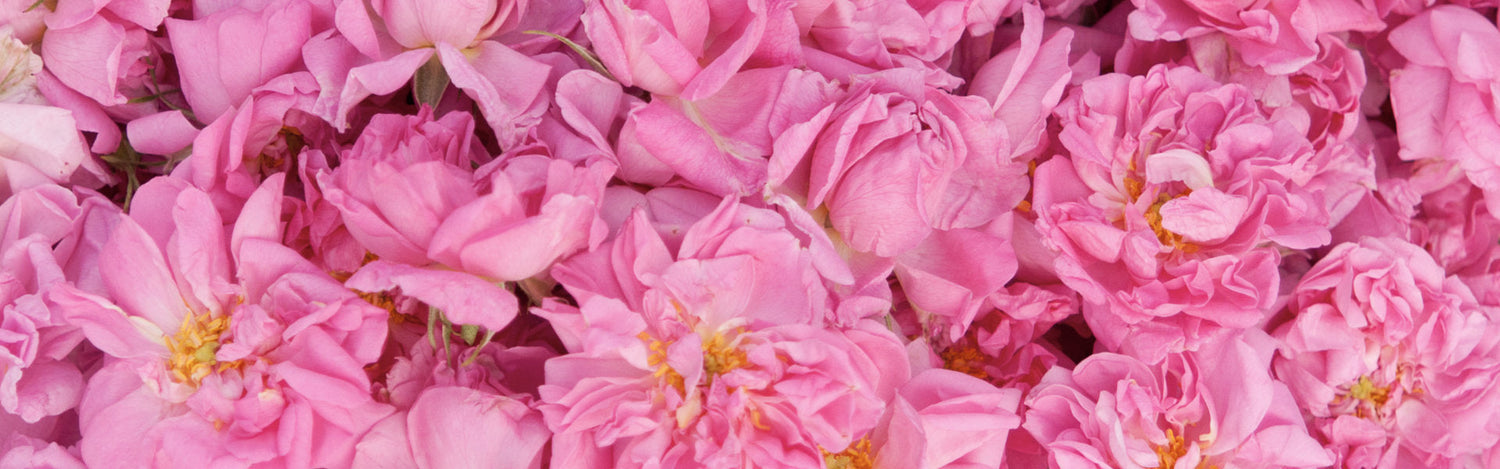
The queen of flowers in perfumery, its sweet and delicate notes have made it indispensable. Used for over 5000 years for its relaxing and stress-relieving properties, it is described as carrying the “scent of love”.
Active on the 4th chakra, the heart chakra, it is ideal for balancing yin and yang.
It is composed of approximately 250 aromatic molecules: 70% phenylethyl alcohol, 10% citronellol, geraniol…
-

SOOTHING
The rose has a positive effect on the psycho-emotional level; its calming properties help to overcome painful events.
-

HEART NOTE
The heart notes give the fragrance its deep identity. Predominantly composed of floral notes, it unfolds over 15 minutes to 4 hours.
-

FLOWER
Very precious and expensive, it takes about 10 tons of rose petals to make 1 kg of rose absolute.


Rose fragrance is not only used in perfumery and cosmetics. Indeed, rose fragrance also has numerous medicinal properties.
For example, extracts of Damask Rose have antibacterial, antioxidant and hepatoprotective actions.
Due to its astringent, regenerating and toning properties for the skin, rose water is widely used for facial care.
Rose oil has harmonizing and aphrodisiac properties.
In aromatherapy, it is notably included in the composition of synergies related to heart problems.
The rose flowers are picked by hand, one by one. More precisely, the rose flowers are picked between 5 and 9 a.m., because this is when the concentration of fragrance is at its maximum.

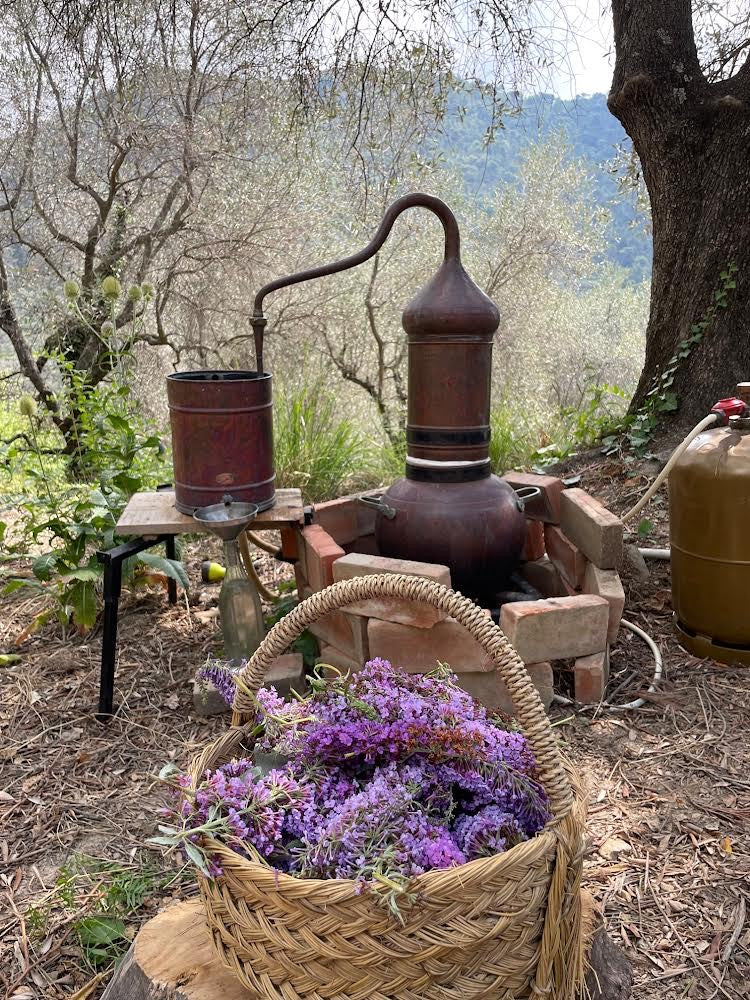
Rose fragrance extraction
The most commonly used extraction technique for obtaining rose essential oils is hydrodistillation.
This technique involves immersing rose petals in a large volume of water heated to 100 degrees Celsius. The steam released by the boiling mixture condenses after cooling in a condenser. Rosewater topped with essential oil is obtained through decantation. The water must be heated for 30 minutes, and the flowers distilled for 1 hour and 30 minutes. For optimal results, a two-step process is necessary. First, a first layer of "direct" oil (representing approximately 20% of the final oil volume) forms by decanting onto the first rosewater. Then, a portion of this first rosewater is distilled again for 1 hour. Thus, after decantation, a second rosewater is obtained topped with a layer of "water-oil."
It is necessary to expose the oil to direct sunlight for several days. This helps to eliminate impurities and allow the water to separate.
The next step is to filter the oil from the water and then mix the two oils. This way, you simultaneously obtain the essential oil and the rose water, which you then mix together.
To produce 1 kg of rose essential oil, it is necessary to distill up to 5 tons of roses, or 200 million petals. As a result, the price of rose essential oil can reach up to 7000 euros/kg.
From the third year after planting, a field of R. x damascena yields approximately 1.5 tonnes of flowers per hectare. In subsequent years, and for about thirty years, this can increase to up to 5 tonnes of rose flowers per hectare.
The rose blossoms are picked by hand, one by one. More precisely, they are harvested between 5 and 9 a.m., as this is when their fragrance concentration is at its peak. Therefore, the blossoms must be distilled quickly.
The second most common extraction technique is solvent extraction. This technique involves washing the flowers three times with a solvent. At the end of the extraction, the solvent is removed by evaporation under vacuum. This technique takes 5 hours and yields rose concrete, a semi-solid product concentrated in fragrance, pigments, and waxes. It is then necessary to treat this concrete with warm alcohol to remove the pigments and waxes. The alcohol is cooled to between 0 and 10°C and then filtered. Evaporated under vacuum, the alcohol produces a product highly concentrated in fragrant molecules (rose absolute). Approximately 400 kg of roses are needed to obtain 1 kg of concrete and 0.5 kg of absolute.
To date, these two techniques coexist. Indeed, they allow for the production of products with different characteristics.
The crop used to make rose perfume
Since antiquity, the rose has been used for its fragrance. Before distillation, perfumed oils were obtained through enfleurage and maceration processes. The fall of Rome in the 5th century led to a decline in the use of rose perfume in Western Europe. However, the Crusaders revived its use in Europe. It was at the end of the 16th century that the distillation of rose flowers began to produce rose essential oil. To date, global production of rose essential oil and rose concrete is estimated at approximately 15 tons. Bulgaria and Turkey are the two main producers (with 80% market share).
The Damask rose (Rosa x damascena Mill.) is the species most commonly used to produce the fragrant essential oil. The rose flower has approximately 30 petals. It is a very fragrant flower.
The rose originated in the Middle East. More specifically, cultivation and extraction techniques were imported from Anatolia in the 16th century.
At the end of the 17th century, essential oil production was established in the Kazanlik region of Bulgaria. This is why the cultivar that produces the finest rose essential oils is named R. x damascena 'Kazanlik'. The plain where this cultivar grows is known as the "Valley of Roses".